Industry Report · June 2026
ELECTRICTRUCKSGO GLOBAL
440,000 electric trucks sold in 2025. A market that doubled in 12 months. But behind the headline, one country is doing all the heavy lifting. And the gap is widening.
440K
EV trucks sold
Global 2025
×2
YoY growth
220K → 440K units
9%
Market share
Up from 4.5% in 2024
19×
China vs. world
405K vs. 21.4K rest
01Overview
The Long Haul
Goes Electric
In 2026, doubting electric mobility in passenger vehicles requires willful ignorance. The numbers are too clear. But heavy trucks? Until recently, they were the last holdout.
2025 changed that. Electric truck sales doubled globally, from 220,000 to 440,000 units. Market share climbed from 4.5% to 9%: a milestone that puts heavy transport on the same trajectory passenger EVs were on in 2019–2020.
97% of those sales are battery electric. The industry isn't hedging on hydrogen or range extenders: it's betting on pure BEV. But two structural challenges remain that passenger EVs never faced at this scale.
Challenge 1: Range
Passenger EVs now routinely exceed 700km. Trucks carry larger packs but also heavier loads over longer distances. Today's long-haul EV trucks are closing the gap fast (the best models already reach 700-800km), but the infrastructure to exploit that range in commercial operations isn't yet there.
Challenge 2: Charging Infrastructure
A medium truck on urban routes returns to a private depot every night. A long-haul heavy truck covering 1,000km has nowhere to charge fast enough. Battery packs on heavy trucks require ultra-rapid charging (400kW+); standard public EV chargers are irrelevant.
"The commercial freight industry operates on razor-thin margins. For fleet operators, switching to EV trucks is a purely mathematical decision. The math is starting to work."
02Market Concentration
China Is Not
Dominating.
China Is the Market.
Add up every EV truck sold outside China (Europe, North America, and the rest of the world combined). You still don't come close to China's number.
EV truck sales by region, 2025 (thousands of units)
The gap has been growing consistently since 2020. China was at 15,000 units that year, already ahead. By 2025, it was at 405,000. Europe went from near-zero to 16,800, a real gain, but still 24× smaller than China's market. North America is barely on the chart.
Why China pulled so far ahead
Three forces combined: (1) urban delivery zones that banned diesel, forcing fleet electrification; (2) state-supported private depot charging and a network of commercial battery swap stations, solving the charging problem without waiting for public infrastructure; (3) an intensely competitive domestic manufacturing base (BYD, SANY, Sinotruk, FAW) that compressed prices faster than anywhere else.
The trajectory from 2020 to 2025 by region:
China vs. Europe: growth in thousands
03Powertrain Shift · China
From 0% to 28%
in Six Years
China's heavy truck market shows the sharpest powertrain transition currently underway anywhere in mobility. In 2020, EVs had zero meaningful share. In 2025, they hold 28%, while diesel ICE has fallen from 91% to 46%.
2020 · Total market: 1.6M trucks
2022 · Total market: 0.5M trucks
2023 · Total market: 0.6M trucks
2024 · Total market: 0.6M trucks
2025 · Total market: 0.8M trucks
Notice the natural gas peak: NG surged from 25% to 30% share in 2024, then retreated to 25% in 2025 as BEV improved. This is the classic "bridge technology" pattern: a cleaner interim solution crests just as the clean alternative reaches cost parity.
Why EREVs were skipped entirely
Extended-Range Electric Vehicles (battery EV with a backup fuel generator) seem logical given the charging gap. The market bypassed them. Reason: EREVs add mechanical complexity that reduces payload capacity and increases maintenance costs. Battery swap stations solve the charging problem more elegantly. The industry concluded EREVs offer fleet operators the worst of both worlds.
04Economics · China · 2025
The Math Is
Getting There
Total cost of ownership per kilometer is where the decision happens. BEV trucks now undercut diesel in China, but natural gas still wins on pure cost.
Natural Gas ICE
$0.79
USD / km, total
Vehicle cost$0.08
Fuel$0.22
Infrastructure$0.02
Dwell cost$0.00
Driver, maint., insurance$0.47
Battery Electric
$0.82
USD / km, total
Vehicle cost$0.19 ↑
Energy (electricity)$0.13 ↓
Infrastructure$0.04
Dwell cost$0.04
Driver, maint., insurance$0.42 ↓
Diesel ICE
$0.93
USD / km, total
Vehicle cost$0.06
Fuel$0.39 ↑
Infrastructure$0.01
Dwell cost$0.00
Driver, maint., insurance$0.47
The critical read: BEV trucks save massively on fuel ($0.13 vs $0.39 for diesel) and modestly on maintenance. But the vehicle acquisition cost is 3x higher: $0.19/km amortized versus $0.06 for diesel. Natural gas trucks currently win on total cost, which explains why NG still holds 25% share. As battery prices continue falling, BEV will cross below $0.79/km, likely within 1-2 years for the Chinese market.
"BEV trucks already beat diesel on TCO in China. They haven't yet beaten natural gas. That gap closes as battery packs get cheaper. And the regulations don't wait."
05Competitive Landscape
Traditional Giants
vs. New Challengers
Unlike passenger EVs (where Tesla created the premium segment before incumbents woke up), the electric truck market is being contested simultaneously by legacy OEMs and a wave of new entrants.
Traditional OEMs
Daimler Truck
Mercedes-Benz Trucks
🇩🇪 Germany/Global
eActros 300, 400, 600, eEconic · eCascadia, eM2 (Freightliner) · eCanter (FUSO)
Volvo Group
Volvo & Renault Trucks
🇸🇪🇫🇷 Sweden/France
FL, FH, FH Aero Electric · E-Tech D, E-Tech T · Mack LR Electric
Traton / VW Group
Scania & MAN
🇸🇪🇩🇪 Sweden/Germany
25P, 40R, 45R, 45S BEV · eTGX, eTGS, eTGM
PACCAR
DAF · Kenworth · Peterbilt
🇳🇱🇺🇸 Netherlands/USA
XD/XF Electric · T680E, K270E · 579EV, 520EV
BYD
BYD Commercial Vehicles
🇨🇳 China/Global
8TT, 8R, 6F, T-Series
Chinese OEMs
SANY · Sinotruk · FAW · Dongfeng
🇨🇳 China / EU export
MOTA 1165, e263 · HOWO TX EV · J6P EV · Tianlong KL EV
Startups & New Entrants
US Startup
Tesla
🇺🇸 USA
Semi Standard Range · Semi Long Range (ramping volume 2026)
US Startup
Nikola
🇺🇸 USA
Tre BEV · Tre FCEV (hydrogen)
Swedish Startup
Einride
🇸🇪 Sweden
Autonomous eBots · remote-operated freight
China / Belgium / US
Windrose Technology
🇨🇳🇧🇪🇺🇸 Global
E700, R700 EV, targeting EU market
The Chinese export play
Chinese manufacturers (SANY, BYD, Windrose) are now selling in Europe. They arrive with price advantages built from a domestic market that is 24× larger than Europe's. The same pattern that reshaped passenger EVs is beginning in trucks. European OEMs have a shrinking window to respond.
06Benchmark Models · 2026
The Vehicles
Setting the Standards
Four commercial models define where the market stands today, from the Chinese export challenger to the European and North American long-haul benchmark.
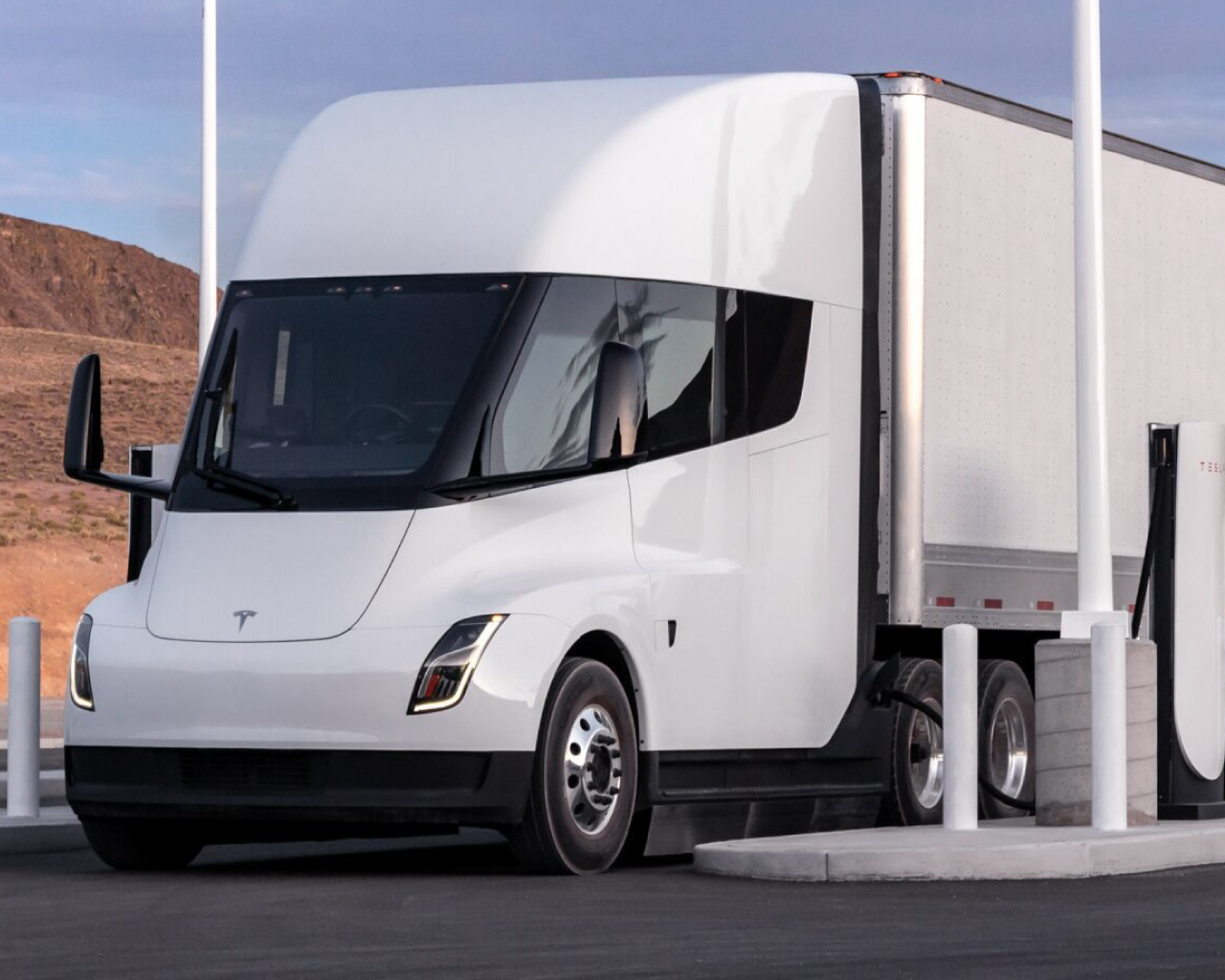 Production
Tesla Semi Long Range
805 kmRange
822 kWhBattery
37.2 tGCW
800 kWPower
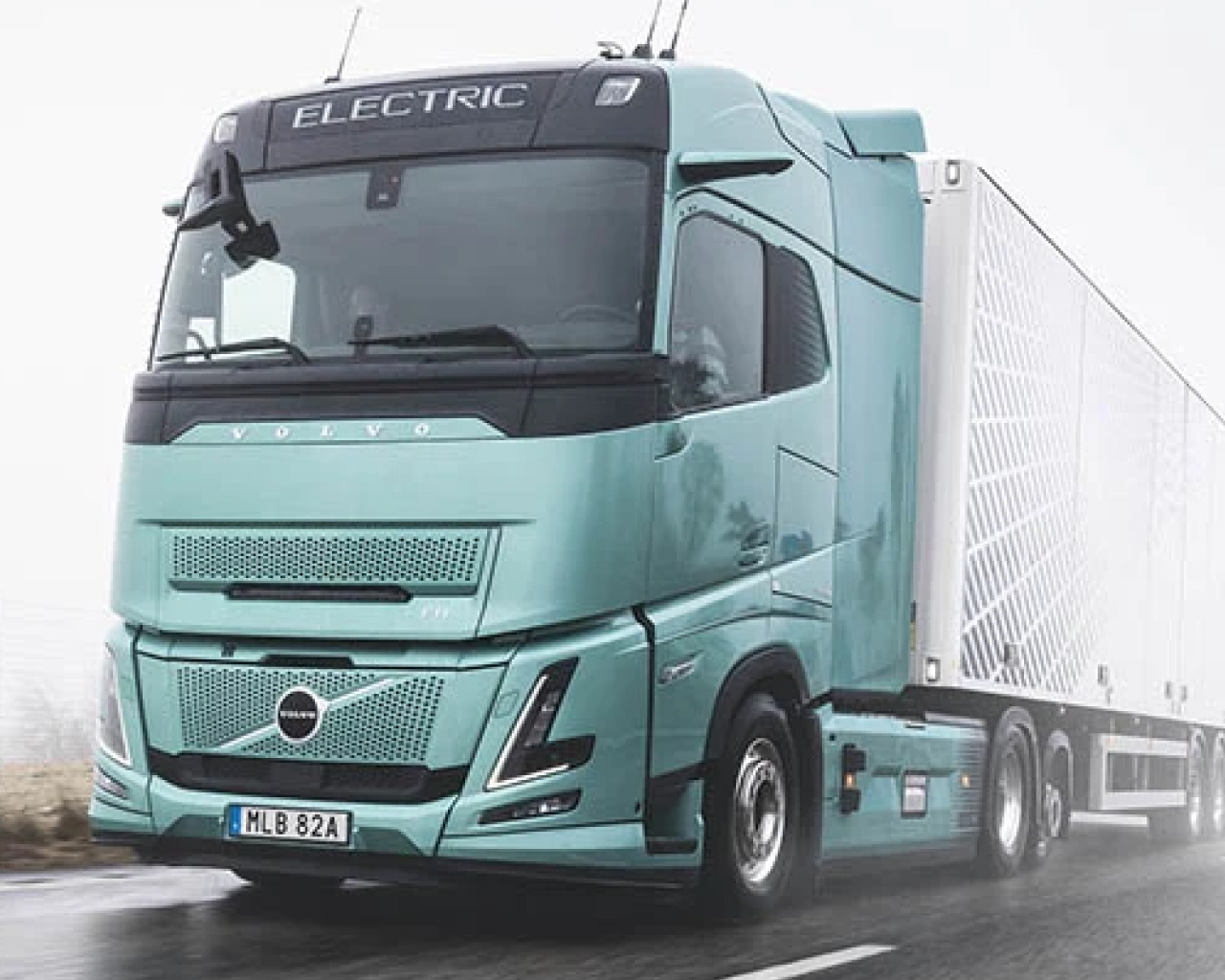 Rollout 2026
Volvo FH Aero Electric
700 kmRange
780 kWhBattery
48 tGCW
460 kWPower
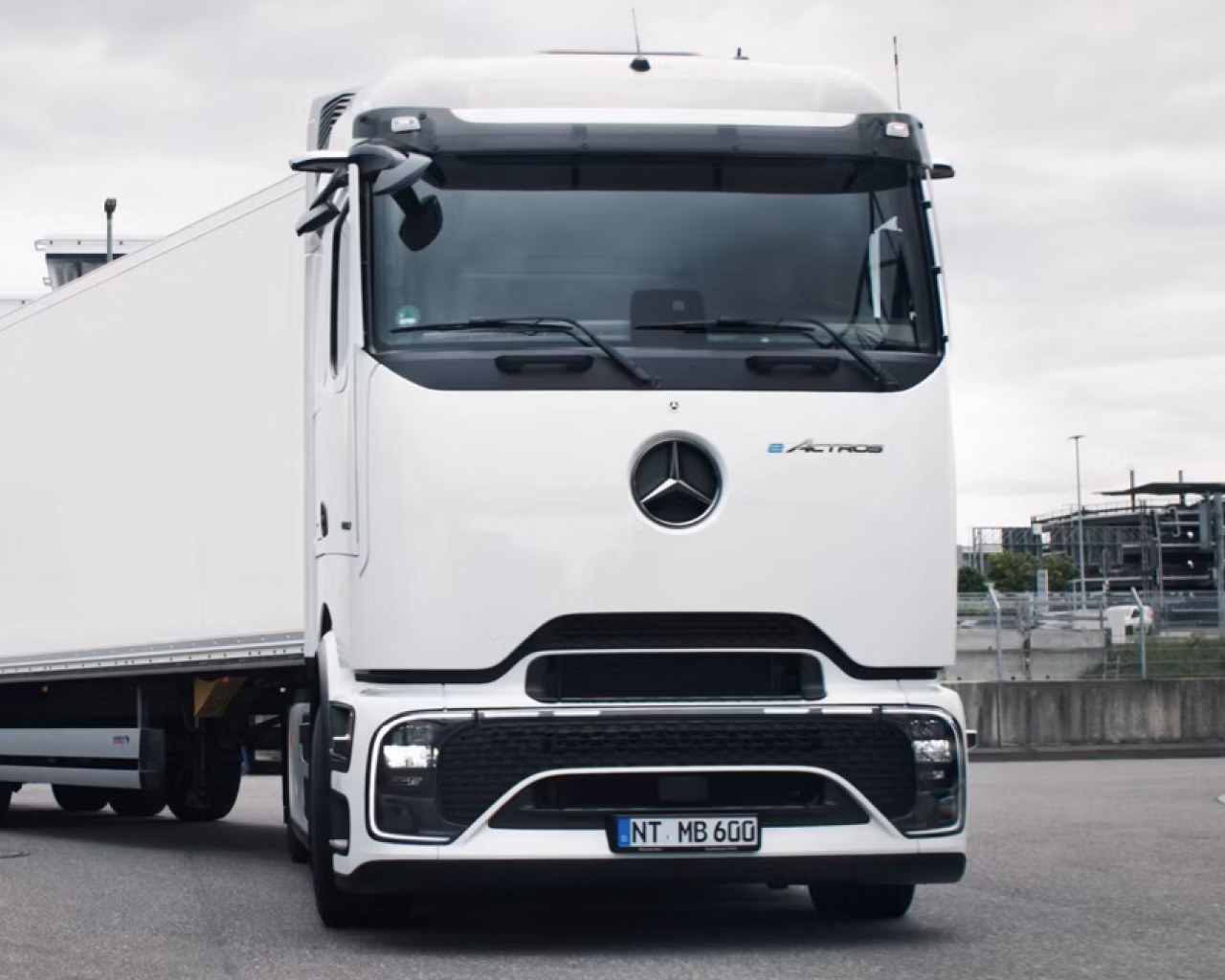 Production
Mercedes eActros 600
500 kmRange
621 kWhBattery
44 tGCW
600 kWPower
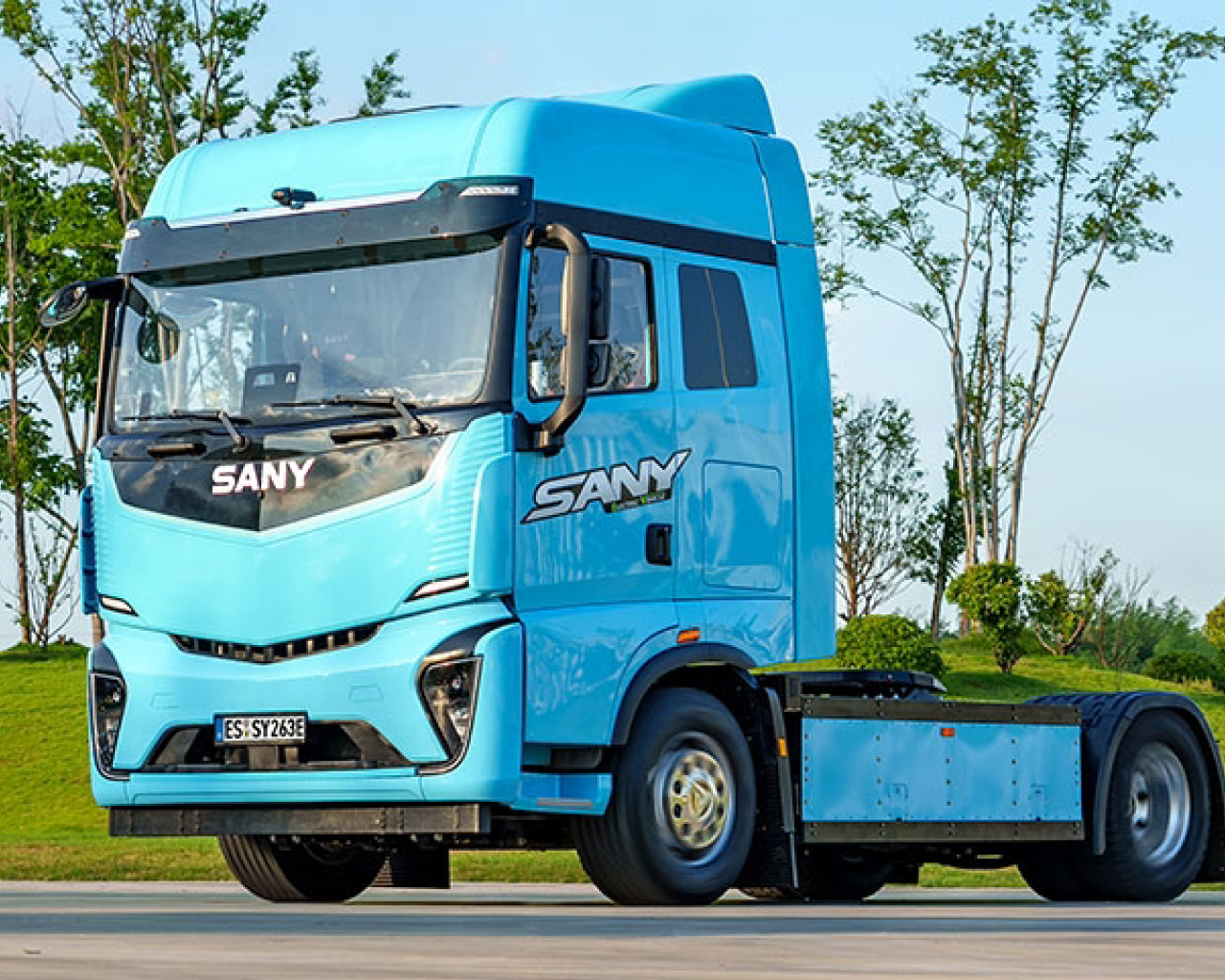 Production
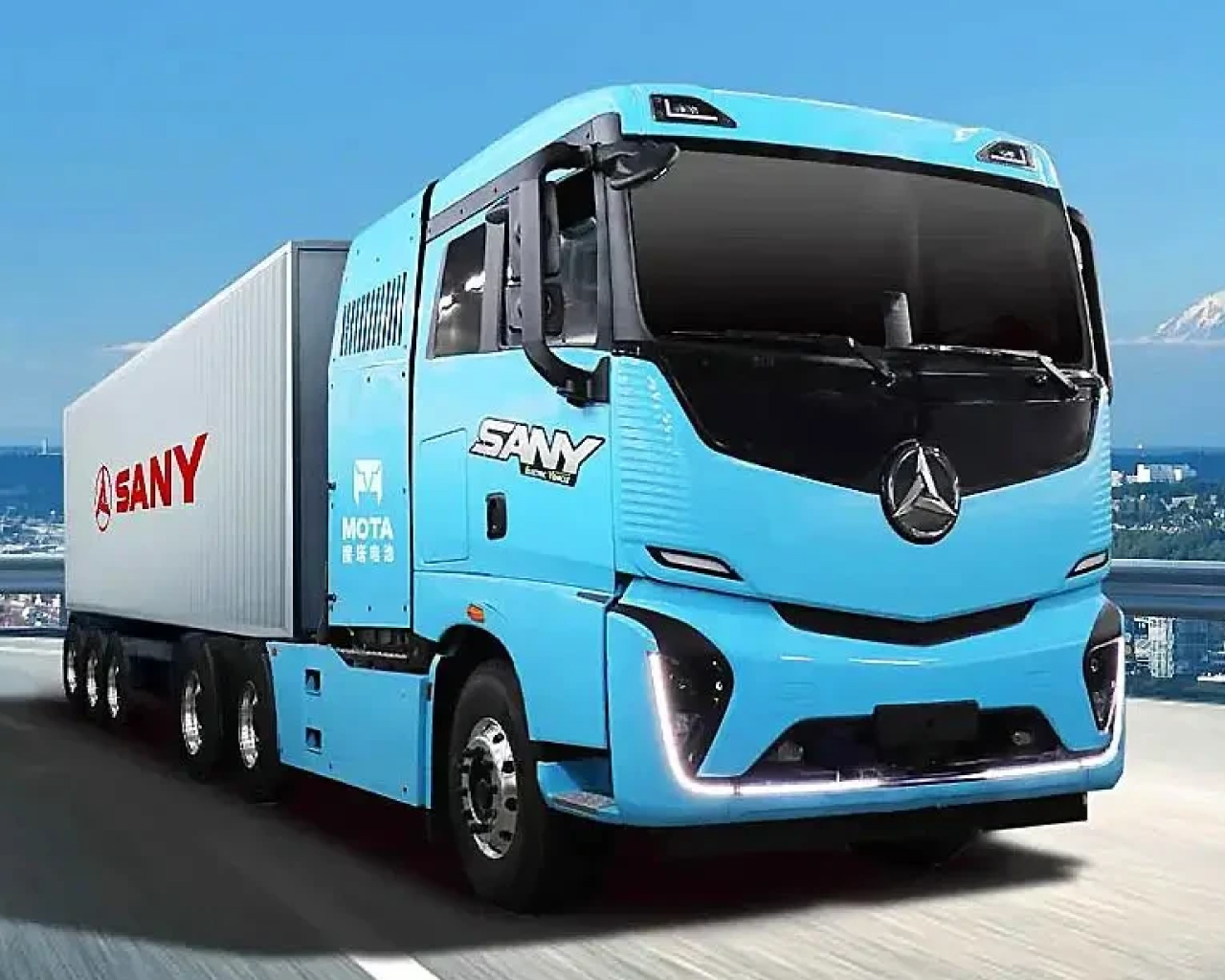
SANY e263
500+ kmRange
636 kWhBattery
42 tGCW
730 kWPower
GCW = Gross Combined Weight. Sources: Tesla official spec sheet, Daimler/Mercedes, Volvo Trucks, SANY/electrive.
What the specs tell us
The 700km+ range barrier has been broken by multiple models. The Tesla Semi's 805km and the Volvo FH Aero's 700km mean long-haul range anxiety is now a charging infrastructure problem, not a battery technology problem. The SANY MOTA's 1,100kWh record-run pack shows where the ceiling is, and it's high enough to make highway charging a solvable engineering challenge, not a physics constraint.
★ Guinness World Record · 2024
SANY MOTA 1165
817.5
km
single charge · electric heavy truck · world record
1,100 kWh
Battery
800 kW
Peak Power
40.6 t
GCW
This is not a commercial truck. It was engineered for one purpose: to show what the physics allow. Today's ceiling is tomorrow's baseline.
Record demonstrator, not available at commercial scale. Source: Guinness World Records; ChinaSPV for battery and charging specs.
What the Numbers
Mean for What's Next
The electric truck transition is real, accelerating, and deeply concentrated. Here's what fleet operators, OEMs, and infrastructure investors need to take from the 2025 data:
- The China playbook is the template. Battery swap networks + aggressive manufacturing pricing + regulatory pressure = mass adoption. Europe and North America are running the same play 3-5 years behind.
- Short-haul is solved. Long-haul is the bottleneck. Urban delivery trucks are already cost-competitive on TCO. Long-haul heavy trucks still face the ultra-fast highway charging gap: that's the next critical infrastructure build-out, and the next investment opportunity.
- Battery cost is the remaining pivot point. When packs reach $80/kWh, the TCO math flips conclusively in favor of BEV across all segments. At current trajectory, that's 2027–2028 for most markets.
- Natural gas peaked. NG trucks hit 30% in China in 2024, then retreated to 25% in 2025 as BEV economics improved. In Europe, regulators are skipping the bridge altogether. Natural gas is a transition, not a destination.
- Watch SANY, FAW, and BYD in Europe. Chinese manufacturers now field world-class products with significant cost advantages. The pattern that played out in passenger EVs is beginning in trucks. Western incumbents have a shrinking window.